A Dying Star, a Swarm of Machine Birds and One Last Shield: The Making of PHØENIX: NEON RISING
Some games you play once and forget. Others stay with you for forty years. For me, it was the bird shooters of the early arcade era: formations sweeping in from the top of the screen, birds peeling off into suicidal dives, and a mothership at the end that seemed impossible to crack. PHØENIX: NEON RISING is my love letter to that feeling, rebuilt from scratch in 3D for Apple TV, iPhone and iPad.
On this page
The idea: keep the soul, change everything else
The rule from day one was simple: keep what made those games great and reinvent everything around it. What stayed:
- Swarms that fly in formation and suddenly dive at you
- A shield that makes you stand still while it is up, so every use is a risk
- A giant mothership as the final test of each round
Everything else is new. There's a story about Kalyx, a dying star whose corona hatches the Pyrids, machine birds of ember and crystal. They are hunting the last light in the system, the lighthouse Halcyon. You fly TALON, the last line of defence.
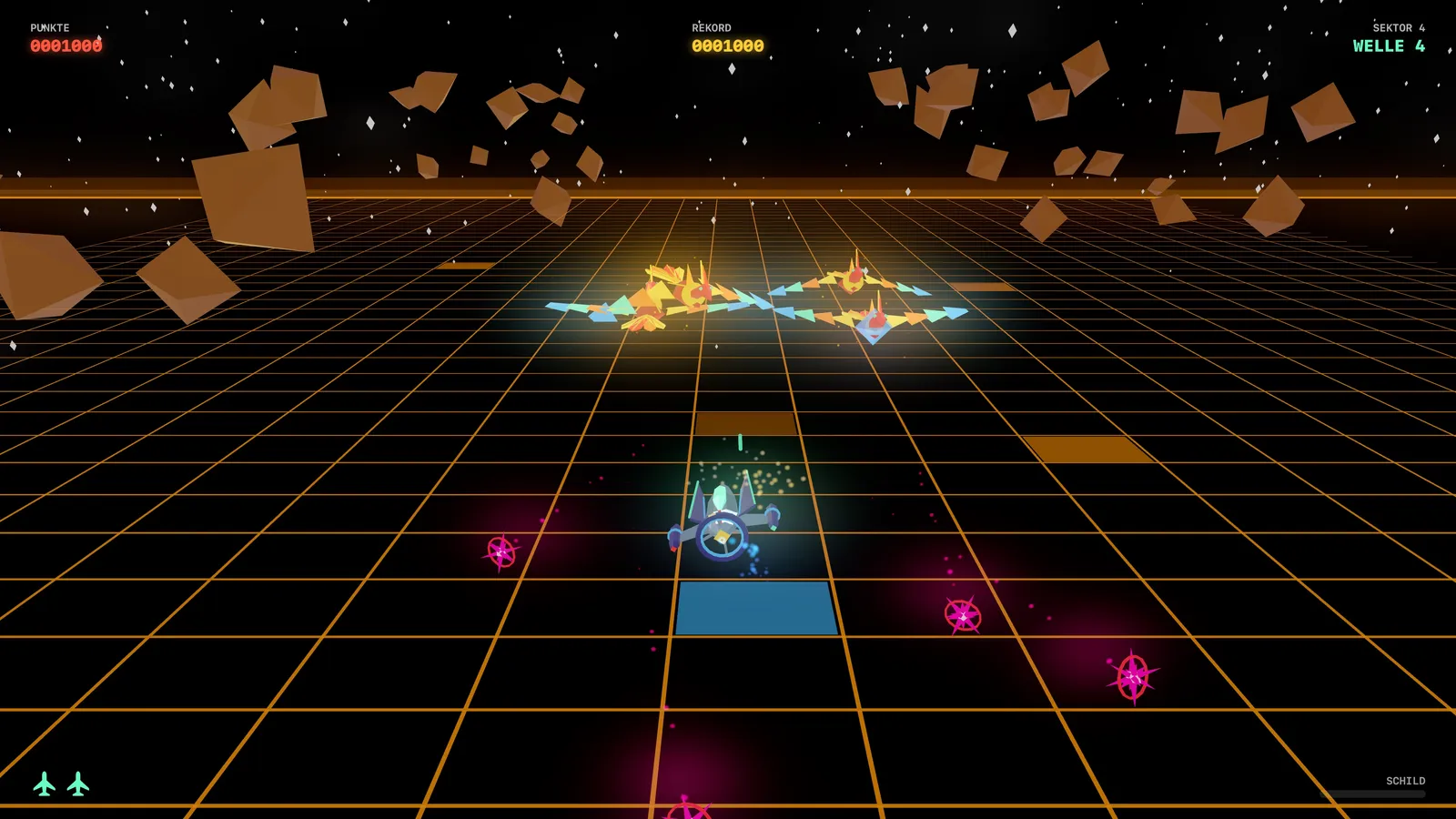
The game spans five sectors, each with its own neon palette and its own music: Ice Rings, Lava Moon, Storm Nebula, Scrap Forge and the Corona itself. Each sector ends with the Brood Ark. It warps in from hyperspace and hatches new enemies from its eggs. A spinning ring of crystal shards shields its Matriarch. The fight has three phases, and every world adds its own twist.
My favourite mechanic is the Perfect Shield. Raise it a split second before an ember hits and it doesn't just block the shot, it hurls it back at the swarm. It turns defence into attack and rewards nerve.
The making: no asset files, just code
PHØENIX was built natively for Apple platforms with Swift, SwiftUI and RealityKit, and almost everything you see and hear comes from code:
- Every model is procedural. The ship, the birds, the crystal phoenixes and the Brood Ark are generated at launch from simple shapes and merged into a handful of meshes. That keeps draw calls low enough for a smooth 60 fps on Apple TV.
- The audio is synthesized live. The game ships without a single audio file. The aggressive lo-fi chiptune soundtrack and every explosion are generated at runtime.
- The neon is alive. The grid pulses to the beat of the music, hits send shockwaves across the floor, and the tiles flash under explosions.
- It feels physical. Screen shake, a short hit-stop on big impacts, controller rumble on Apple TV and haptics on iPhone make every hit land.
- The game logic is deterministic. It runs on a fixed 60 Hz tick, separate from rendering, which made precise hit detection and fair difficulty tuning far easier.
Apple TV with a gamepad was always the main target. The game belongs on a big screen with a real controller in your hands. On iPhone and iPad it brings its own arcade cabinet: a brushed-steel touch panel with a stick and two fat buttons. There is also a "Reduce flashes" option for sensitive eyes, which follows the system's Reduce Motion setting automatically.
And true to its spirit, the game is honest: no account, no ads, no in-app purchases, no tracking. Your high scores stay on your device.
The website
To match the game, the official website is a small playground of its own. A live Three.js scene recreates the neon world: a scrolling grid, a synthwave sun, TALON following your mouse and a swarm of Sparks you can shoot with a click. As you scroll through the five sectors, the whole 3D world changes its colours to match each one. The story is typed out by an 80s terminal. Like the game, the site uses no cookies and no tracking.
Coming soon
PHØENIX: NEON RISING is coming soon to the App Store for Apple TV, iPhone and iPad. Grab a controller, find the biggest screen in the house, and see how long you can keep Halcyon shining.
Visit the official site →